Eivissa combines fortified Dalt Vila, harbour neighbourhoods and museums connecting antiquity with contemporary creativity. Eight urban stops divide the visit into manageable blocks with time for slopes and breaks. This guide focuses on the town; outings to other villages require separate planning.
Start between harbour and walls, cross ses Taules and choose Puget as an interior before reaching the cathedral. Pause uphill and view the harbour from above. This includes neither guaranteed access to every space nor a step-free circuit.
Start at Vara de Rey, allow a MACE block and view Sant Pere outside. Continue beyond Dalt Vila to Puig des Molins with dedicated time. These are separate museums connected by streets and gradients: adapt the order to opening and breaks.
An outing to another municipality for the fortified hilltop church and coastal views. Can Ros can broaden the rural-history theme if its museum is open; it is not automatically included with church access.
Check Alsa Ibiza for the current Santa Eulària connection and return. Add the uphill journey from the town; leaving the bus is not the same as reaching the monument.
Exchange harbour and walls for an inland village arranged around church and square. Study the porch and shared space before taking a break. A village walk does not imply a daily operating craft market.
Check the island network for your date-specific Santa Gertrudis stop and service, planning the return. Keep this separate from Santa Eulària if connections do not fit.
The small centre offers another relationship between religious architecture and village life. The fortified church and square form the outing's core. Do not automatically add sa Talaia or coves: hiking and beaches require different time and conditions.
Arrange road travel with Alsa Ibiza or your own transport and confirm the return. Church interiors depend on opening and worship; the exterior does not guarantee entry.
Choose one ascent and one museum. In the lower town find boats and façade shapes; in Dalt Vila compare gateway, bastion and street. Bring water and allow toilets and meals. Workshops depend on programming; tombs, steps and paving must not be presented as accessible without assessment.
In the rain
Prioritise confirmed MACE and Puig des Molins galleries with a meal break. Puget requires travel on the slope. Shorten wall walks in rain or wind and check notices: bastions and archaeological grounds are not covered shelters merely because they are heritage sites.
What to try and where to pause
Local cooking has its own story: ask about Ibizan recipes and desserts such as flaó or greixonera without assuming every menu includes them. Ca n’Alfredo and La Brasa allow a lower-town meal plan. Confirm season, dining space and allergens; eating before an ascent helps organise the day.
Sources for this update
Consell de Ibiza · Puig de Missa, Santa Eulària
Consell de Ibiza · Santa Gertrudis de Fruitera
Turismo Sant Josep · iglesia y pueblo
Aena · acceso desde aeropuerto
Alsa Ibiza · red vigente
Choose your walk
Durations are indicative: queues and all indoor visits are not included.
Plan my route
Street map
OpenStreetMap loads on request. Markers are indicative, not audited entrances. Use links for street directions.
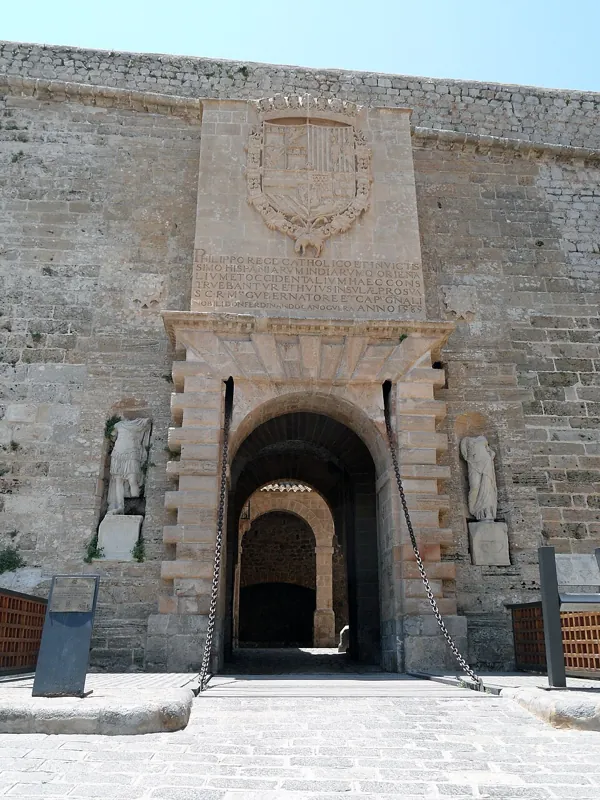
Portal de ses Taules marks a change of scale between the harbour neighbourhood and the fortified town. Its ramp leads to an entrance within Dalt Vila's Renaissance defensive system. Crossing it reveals how walls also organised who entered, where and under whose supervision. Before climbing, notice the mass of masonry and how the approach channels movement. Pause afterwards in the parade ground known as the Rastrillo, then continue towards Plaça de Vila. Compare the gateway from both sides: outside, defence dominates; inside, streets, homes and everyday activity emerge. Take the ascent slowly, especially in hot weather. Passing through this historic entrance does not guarantee access to every bastion, interpretation space or museum within the enclosure.
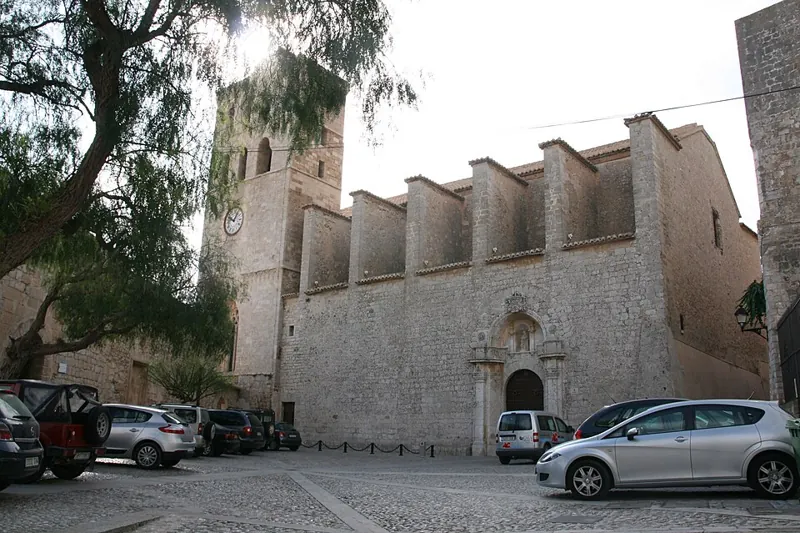
The cathedral crowns Dalt Vila, yet its history involves more than one building campaign. Santa Maria church followed the Catalan conquest of 1235 and received medieval extensions and later alterations. Cathedral status arrived in 1782, so the building and its ecclesiastical rank belong to different moments. Begin with tower and apse, then compare their language with the nave remodelled in the eighteenth century. Reading separate parts helps identify each period's contribution. Change position in the square to look towards the harbour, then turn back to the façades: the height explains both the commanding view and the effort of reaching it. Check current access for the church and Diocesan Museum; worship can affect tourist visits.
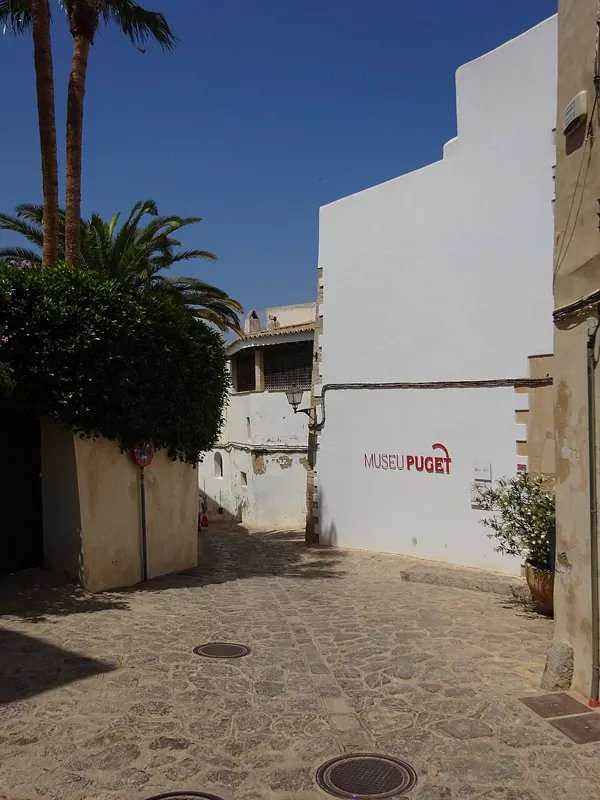
The Puget Museum looks at Eivissa through its people, landscapes and everyday scenes. It occupies Can Comasema, a noble house in Dalt Vila whose courtyard and Gothic details belong to the experience alongside the paintings. The collection comes from Narcís Puget Viñas and Narcís Puget Riquer, father and son, rather than two interchangeable names for one artist. Choose a scene and consider what it reveals about work, clothing, gestures or relations with the street. Compare it with what you saw near the harbour: a painting preserves a viewpoint, not a neutral photographic record of the whole island. Allow time for the domestic architecture too. Check open galleries and exhibitions, since temporary programming can alter the visit.
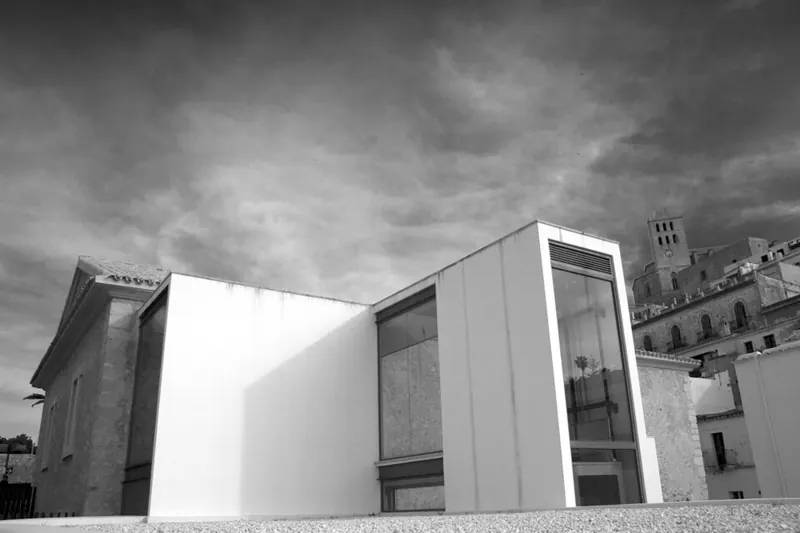
MACE introduces a creative Eivissa that extends beyond the ancient-town image. Founded in 1969, it grew from the biennial begun in 1964 and occupies the former armoury inside the walls. The contrast between defensive architecture and contemporary work invites a different approach: an artwork may organise space, question a word or employ unexpected materials. Instead of hurrying through every gallery, choose one piece and spend a few minutes with it before reading its explanation. Ask how it relates to the light, building and neighbouring works. Collection displays and temporary exhibitions follow different rhythms; consult the current programme rather than assuming an older advertised show remains present. Give the museum its own block within your walk.
Joan Gené · CC0 · Wikimedia Commons · Versión reducida
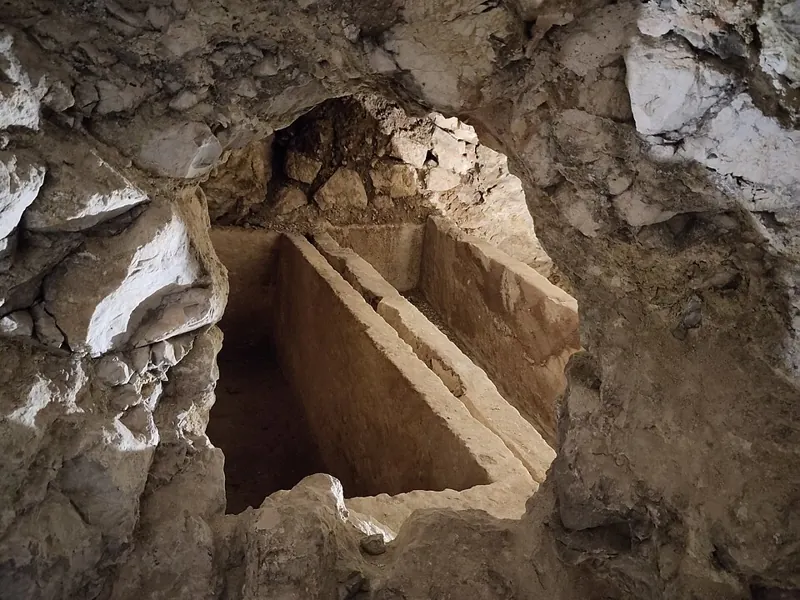
Puig des Molins moves beyond the walls to the ancient town. Phoenician founders used this hill as a cemetery from the mid-seventh century BCE, and successive communities left different ways of treating their dead. The museum interprets objects that might otherwise appear merely decorative. Choose a vessel, figure or mask and ask what its context tells us and what remains open to interpretation. Relate the galleries to the archaeological site and underground tombs without assuming every area can be explored. Separate the museum visit from descending into burial spaces: access, capacity and comfort differ. Respect the archaeological setting and organise this block from the Vía Romana entrance, outside the upper fortified town.
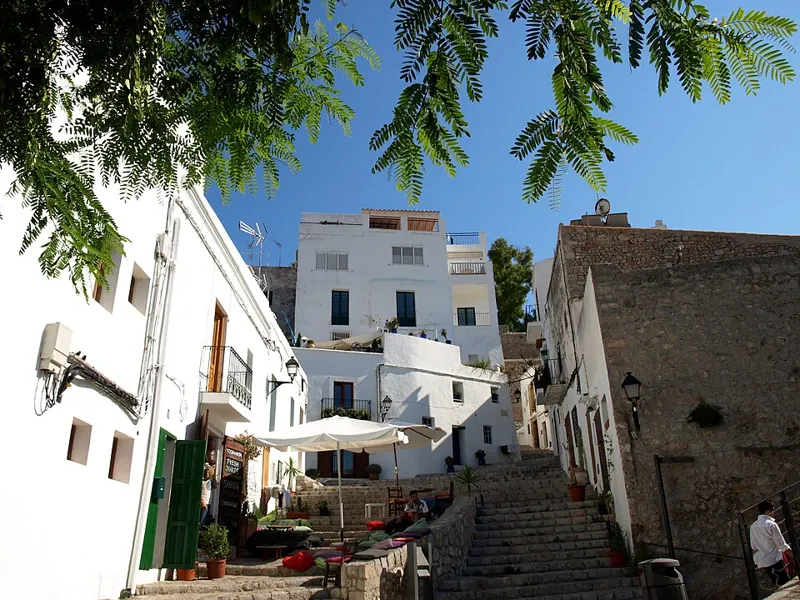
Dalt Vila street · contextual photograph, not Baluard de Sant Pere · steve p2008 · CC BY 2.0 · Wikimedia Commons · Versión reducida
Sant Pere shows that a fortress was more than a wall around houses. Associated with Portal Nou, the bastion arranges access through projecting shapes and protected approaches; above, the Cavaller de Sant Lluc added an artillery position. Study the rounded defensive projection and compare its geometry with the streets behind it. The tunnel towards Parc Reina Sofia provides a connection between lower and upper town different from the main ses Taules entrance. The complex also hosts cultural uses and interpretation, whose access needs checking for your date. You need not imagine a battle to understand it: follow where each approach could be watched. Pause at the exterior without assuming the climb is suitable for every mobility requirement.
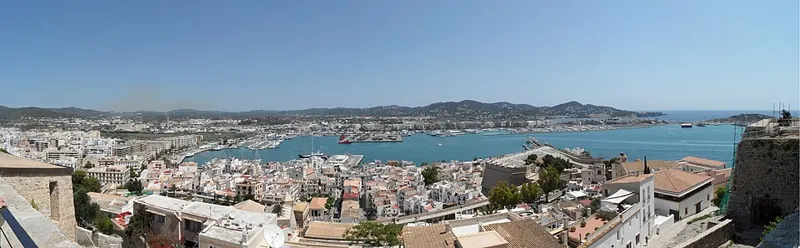
La Marina returns the walk to sea level and to people who worked outside the walls. Sailors, families and shipyard workers lived between harbour and Dalt Vila; this was never simply scenery for travellers. The Mercat Vell and Sant Elm church recall trade, food supply and the organisation of a maritime community. Explore a few streets before sitting at a terrace, noticing narrow façades, passages towards the water and the wall above. Compare this area with the upper town's squares: they reveal different ways of inhabiting one city. Commercial activity varies by season and time of day, so an operating market or particular scene should not be promised as a permanent part of the route.
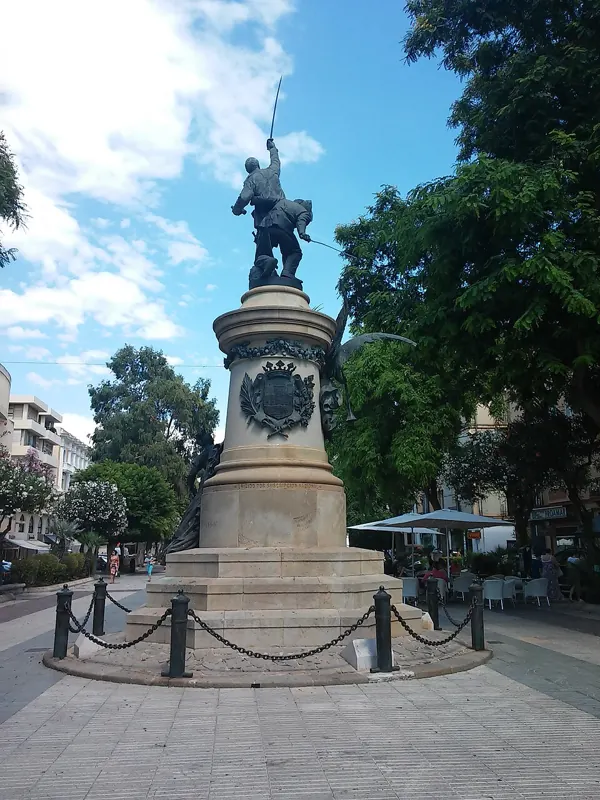
Vara de Rey reveals Eivissa's growth beyond its historic enclosure. The promenade helped launch the late-nineteenth-century expansion, and its width contrasts with La Marina's lanes and Dalt Vila's slopes. Begin with the façades, including Montesol, then examine the central monument inaugurated in 1904 in memory of General Joaquín Vara de Rey. Separating architecture, public space and memorial helps show that they did not all emerge together. Find a bench or shade and watch how people cross the promenade, meet or continue towards the harbour. It is a useful place to begin or end the day, and to take a proper break between museum and ascent without making every minute another admission.
Traditional Ibizan restaurant on Vara de Rey, an option for a meal between lower town and Dalt Vila. Confirm opening, menu and booking directly; particular dishes and set menus are not assumed available daily.
Mediterranean option near the walls and Plaça del Parc with a planted terrace. Confirm your dining area, seasonal arrangements and dietary needs; the listing includes no reservation or guaranteed menu.
Editorial selection based on official tourism listings, without a personal visit or sponsorship. Check opening, menus, allergens and prices before visiting.
Optional activities, separate from the independent walk. The private-tour listing advertises a Spanish-speaking guide; check the specific language when booking each activity. The free tour operates on tips. Confirm dates, meeting point, access and conditions on Civitatis. This guide language does not determine the tour language. Affiliate links: we may earn a commission if you book. Checked on 20 October 2026.
From Ibiza Airport (IBZ), Aena lists AERO2 via Sant Jordi and AERO3 Express towards town. Check Alsa Ibiza for the useful stop, date-specific service, fare and final return; review old references to line10 before relying on them. Arriving by boat, confirm terminal and berth with your operator before planning the transfer: not every harbour arrival is beside La Marina. CETIS bus station also requires onward travel to the old town. Dalt Vila has slopes, steps and stone paving, with restricted traffic; this route is no accessibility audit. There is no train or metro. Check current bus lines or arrange your own transport for village outings without assumed frequencies. Markers indicate the surrounding area, not audited entrances. Reach the lower town before starting Dalt Vila. Aena distinguishes AERO2 via Sant Jordi and AERO3 Express from the airport; check stop and date with Alsa Ibiza. Harbour arrivals require the terminal confirmed with your ferry company. Start with Vara de Rey and La Marina rather than climbing with all your luggage.