Two hours
Two hours: Plaza Alta, Alcazaba surroundings, Giralda and cathedral exterior. Choose a wall section rather than the entire enclosure; no museums or complete bridge crossing.

WHAT TO SEE AND HOW TO PLAN
Understand Badajoz between the Alcazaba hill, old-town squares and Guadiana. The centre links Plaza Alta, Giralda and cathedral; museums and a full Palmas Bridge crossing need separate time. Walking around the fortified enclosure does not guarantee entry to towers or interiors.
Durations are indicative: queues and all indoor visits are not included.
Two hours: Plaza Alta, Alcazaba surroundings, Giralda and cathedral exterior. Choose a wall section rather than the entire enclosure; no museums or complete bridge crossing.
One day: Alcazaba and Plaza Alta in the morning, choosing the archaeological museum if open. Central lunch, Giralda and cathedral in the afternoon; finish at Palmas Gate without requiring a full bridge round trip.
Two days: Alcazaba, archaeological museum and Plaza Alta first. Giralda, MUBA with available galleries confirmed, cathedral and Guadiana on the second. Cross the bridge in a dedicated block; Elvas or Mérida are separate trips with separate transport.
Families: Plaza Alta and a short Alcazaba section with breaks, or a museum suited to interests and age. View Palmas Gate without crossing the whole bridge. The ascent and heat favour shorter distances rather than eight compulsory stops.
Rain: prioritise the archaeological museum, MUBA and cathedral with opening confirmed, plus a central meal. General opening does not mean all galleries are accessible. Shorten walls and bridge in wind or slippery conditions.
OpenStreetMap loads on request. Markers are indicative, not audited entrances. Use links for street directions.
Audio uses your device voice and depends on your browser. The full text is always available to read.
1 / 8 · BADAJOZ
Separate outing beyond the central walk
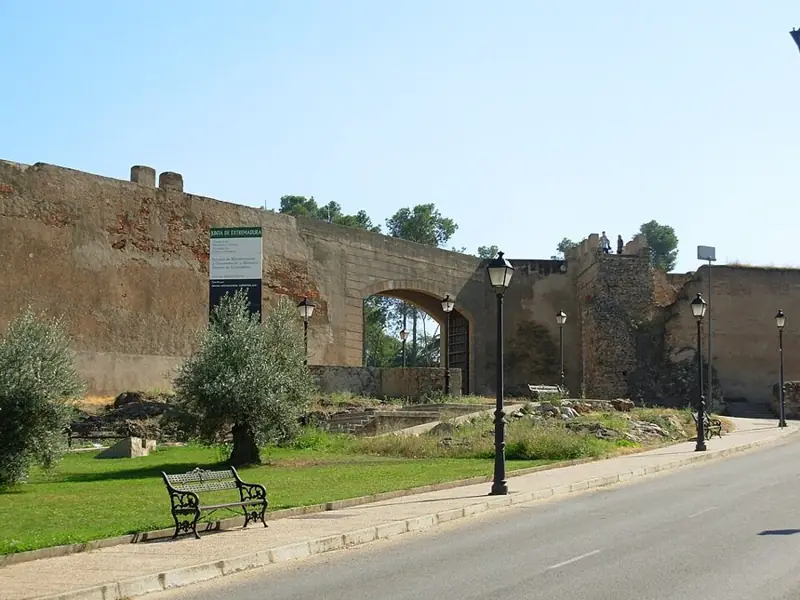
The Alcazaba places Badajoz’s origins on an elevation overlooking the Guadiana. Ibn Marwan’s ninth-century foundation began a history of extensions, changing governments and different uses. Walls, gateways and archaeological remains do not all belong to the same building campaign. Espantaperros tower, octagonal and projecting beyond the enclosure, illustrates how an outlying defensive tower could watch the surroundings without merging into the main wall. Spaces of government, religion and residence existed within the complex; the palace housing the museum adds another historical layer. Walking around the enclosure and enjoying its views is different from entering individual towers or buildings. Their opening arrangements need separate checking, because access to the wider monument does not automatically provide access to every interior.
Explanation source ↗2 / 8 · BADAJOZ
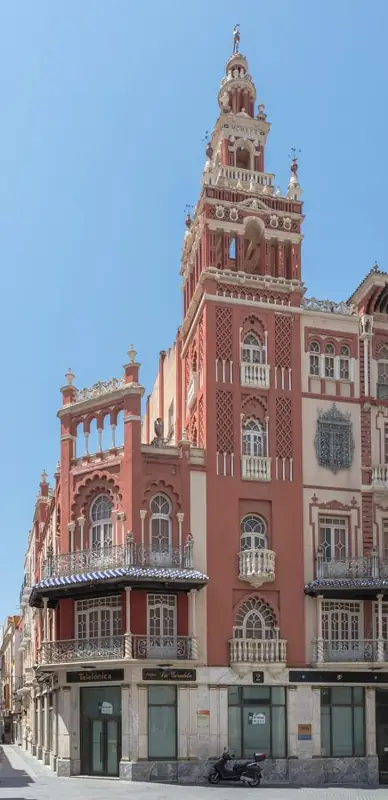
Badajoz’s Giralda shows how commerce also produced buildings that became urban symbols. Built during the early decades of the twentieth century, its regionalist architecture uses neo-Moorish references, ceramics, tiles and ironwork to attract attention across La Soledad Square. Mercury at the top explains part of the programme: residence and commercial activity shared one prestigious public image. The first chapel of Our Lady of Solitude had occupied this site, so its transformation combines religious memory with urban modernisation. Compare the square’s two towers, which have different functions and architectural languages. This stop is designed for exterior viewing. Admiring the façade does not imply that the building offers tourist admission or that visitors can climb its tower for a panoramic view.
Explanation source ↗3 / 8 · BADAJOZ
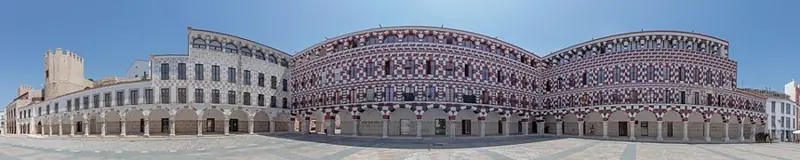
For centuries Plaza Alta was a principal stage for public life in Badajoz. Facing the Alcazaba, its open space and arcades brought together commerce, administration and celebrations. Some unified frontages were built in the seventeenth century under Bishop Marín de Rodezno, while surrounding buildings belong to other periods. The Arch of Weights connects with San José Square and recalls the regulation of weights and measures, a practical task within the urban economy. A metal market once stood in the square before being moved to the university campus. Look beyond the geometric decoration of its façades: the spacious layout, sheltered arcades and connections explain how meetings and activities gathered below the city’s fortified seat of power over successive generations.
Explanation source ↗4 / 8 · BADAJOZ
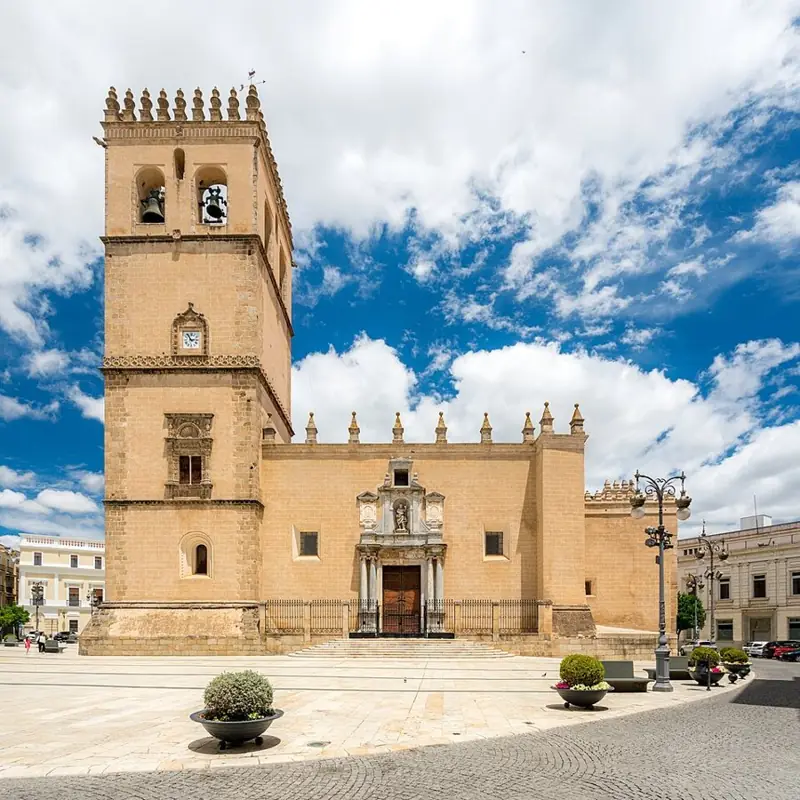
The cathedral shifted Badajoz’s religious focus from the Alcazaba enclosure towards Campo de San Juan. After the Christian conquest of 1230 and the organisation of the diocese, construction developed over many generations. Today’s building grew especially during the fifteenth and sixteenth centuries, with later alterations explaining its mixture of styles. From the square, the bell tower and crenellated upper edges create a solid, imposing image. Inside, late Gothic vaulting, choir and cloister introduce other forms of representation. The dedication of 1276 is commemorated by its anniversary in 2026. Worship, museum admission and a guided tower ascent are different activities. Consult the official programme to choose the experience you want to include rather than assuming every part forms one unrestricted visit.
Explanation source ↗5 / 8 · BADAJOZ
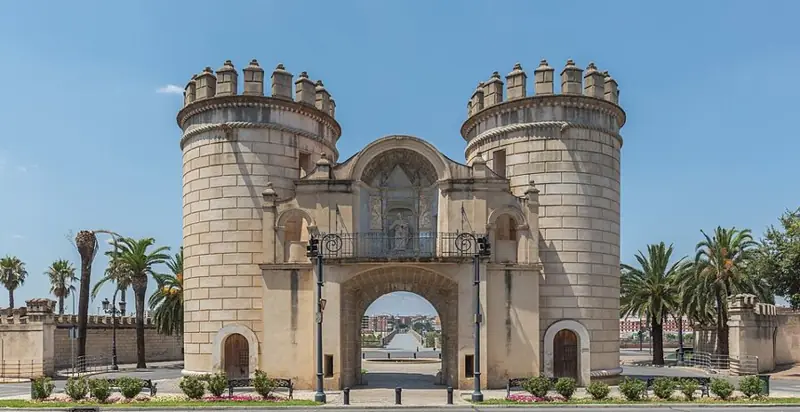
Palmas Gate turned entering Badajoz into a visible statement of power. Two cylindrical towers frame the passage facing the bridge, while its arch and Renaissance decoration create a ceremonial frontage. An exterior inscription refers to 1551, during the reign of Emperor Charles V and the time of Prince Philip. The monument was not merely decorative: it controlled entry and served customs and taxation functions. Its towers were also used as a prison, reminding us that one gateway could combine surveillance, punishment and representation. Compare both sides to see their different compositions. Today it stands as a freestanding monument; walking around the exterior and any admission to internal rooms involve different arrangements and should not be treated as the same experience.
Explanation source ↗6 / 8 · BADAJOZ
Separate outing beyond the central walk
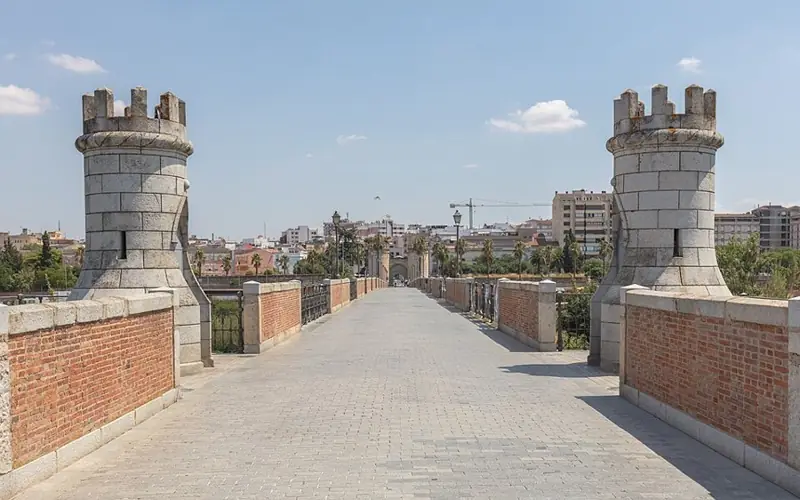
Palmas Bridge tells a story both of connecting the banks and of the Guadiana’s force. The bridge completed in 1596 later suffered floods that required repairs and reconstruction; its present appearance retains traces of those interventions. Before the earliest bridges, people crossed by boat or used fords when conditions allowed. The structure changed movement, trade and connections with roads beyond the city. Examine arches, piers and cutwaters without expecting a uniformity that history did not preserve. Looking towards Palmas Gate reveals bridge and gateway as parts of one strategic entrance. Crossing the entire bridge and returning adds distance to the walk. You can also interpret the ensemble from the city end, leaving the opposite bank for another time block.
Explanation source ↗7 / 8 · BADAJOZ
Separate outing beyond the central walk
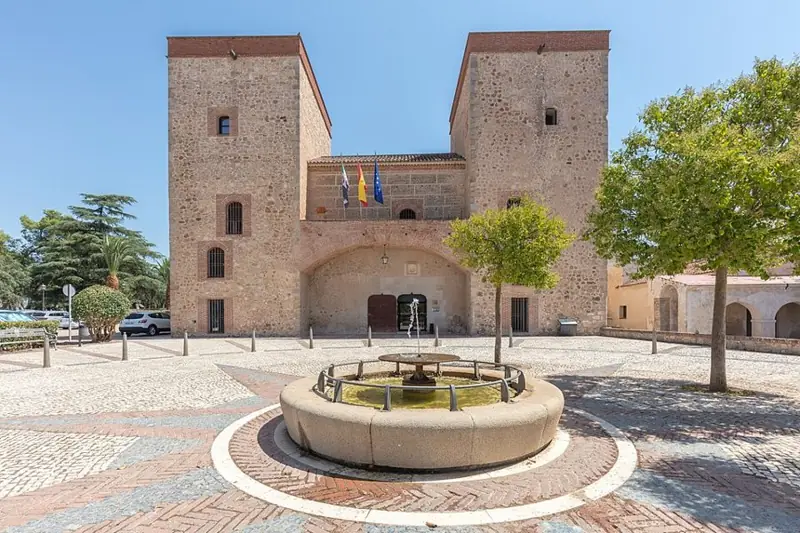
The Provincial Archaeological Museum introduces a story longer than that of Badajoz itself. Its home, the fortified palace of the Counts of Roca within the Alcazaba, is already part of the experience before you reach the displays. Collections range from prehistory to the medieval world, explaining communities and territories across the province. Bronze Age stelae are among the notable groups: carved stones whose figures and objects invite questions about what those societies intended to represent. Compare their visual communication with Roman, Visigothic and Islamic material along the route. The museum does not replace visits to the sites where objects originated; it brings evidence together to interpret them. Admission and opening times are independent of a walk around the Alcazaba enclosure.
Explanation source ↗8 / 8 · BADAJOZ
Separate outing beyond the central walk
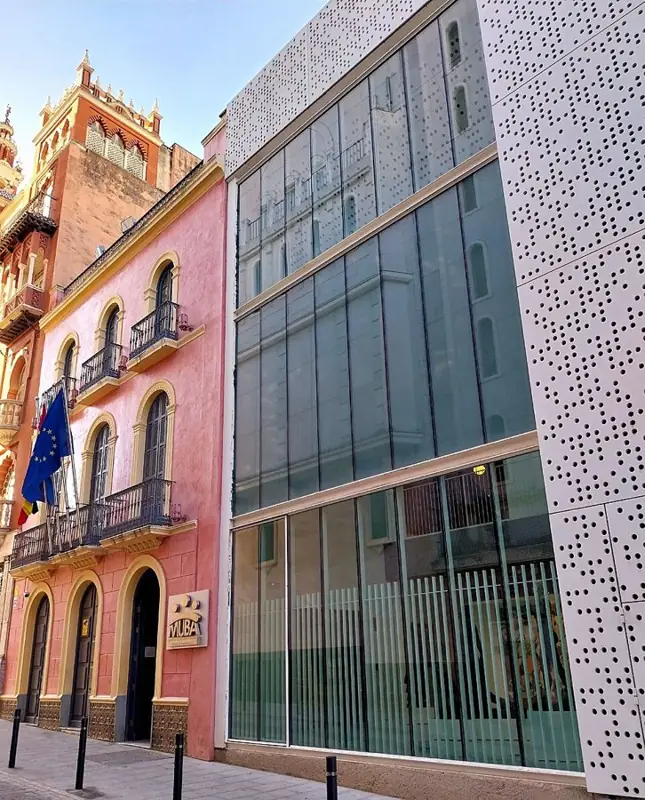
MUBA offers a view of Extremadura through those who painted, sculpted or reinterpreted it. Its origins connect with provincial support for artists from the nineteenth century: scholarships, works sent back by recipients and donations helped build a public collection. The museum began in 1919 and opened its first galleries in January 1920. Its route includes Luis de Morales, Zurbarán, Eugenio Hermoso, Adelardo Covarsí and Juan Barjola, without reducing the region to one artistic style. Compare landscape, portraiture and scenes of everyday customs to discover how each period’s viewpoint changes. The collection occupies several connected buildings. Check which galleries are currently open, particularly given announced rehabilitation works, rather than assuming that every space in the complex is available during your visit.
Explanation source ↗Plaza de Cervantes, 13, Badajoz
Central tapas and sharing plates, including black-garlic pork fillet and grilled octopus on its menu. Check availability and book directly.
Official website ↗ · Walking directions ↗Calle Bartolomé José Gallardo, 6, 06001 Badajoz
Urban fusion restaurant with fish, meat and rice dishes. Its website offers the menu and table availability.
Official website ↗ · Walking directions ↗Carretera de Cáceres, 37, 06007 Badajoz
Family-tradition restaurant offering meat, fish and prepared dishes. Outside the compact old-town circuit: arrange transport and a reservation if choosing it.
Official website ↗ · Walking directions ↗Editorial selection based on the venues’ own websites, not a personal dining review or sponsorship. Check opening, menus, allergens and prices before visiting.
Check final prices, conditions, tour language and availability on Civitatis. Optional paid activities; affiliate links may earn a commission. Badajoz–Elvas is a separate outing to Portugal, outside the city walk; check pickup and conditions.
See activities in Badajoz ↗Aena lists TUBASA route12 between Valdepasillas, Villafranco, airport and Balboa. Distinguish weekday services from the BusKme demand-responsive bus on Saturdays, Sundays and holidays, organised through the app. Check current schedules rather than assuming a departure for every flight. Verify Renfe trains and plan the station-to-old-town connection. The centre involves walking and the Alcazaba an ascent. Marchivirito lies outside the compact route; Elvas and Mérida require separate journeys. Map markers are approximate and accessibility has not been audited.
Emergencies: 112. For non-urgent medical assistance, consult local services.